
If you hold a mortgage, it probably feels like the Reserve Bank of Australia has a personal grudge against you. Every time they increase the cash rate, your disposable income takes a direct hit. And it is entirely reasonable to feel like they are targeting you to solve a national problem.
But the cash rate isn’t like a laser pointer aimed at your home loan. It is more like the thermostat to an air conditioner in a massive Australia sized house. And right now, the Australian economy is overheating.
Think of the entire country as a giant house. Over the last few years, everyone was moving around, working hard, and we all generated a lot of heat. Businesses were hiring frantically, global supply chains changed, and consumer spending surged. The economic temperature skyrocketed, and that blazing heat is what we call inflation. It devalues your savings, drives up the cost of groceries, and makes everything unlivable.
To fix this, the RBA has to turn on the air conditioner to cool the house back down to a comfortable 2% to 3% target zone.
The catch? The RBA only has one thermostat dial, the cash rate, and the vents to that air conditioner aren’t evenly distributed. Mortgage holders happen to be sitting directly underneath the main vent. You are feeling the icy blast first, and it freezes your budget.
But while you are shivering under that vent, the cold air is quietly moving through the rest of the house. Higher rates mean commercial banks stop handing out cheap money, businesses put massive expansion plans on ice, and savers suddenly lock their cash away in high-yield accounts rather than spending it. The thermostat is adjusting the climate for everyone. Mortgage holders just happen to be on the front line of the breeze.
How the Chill Spreads Beyond the Living Room
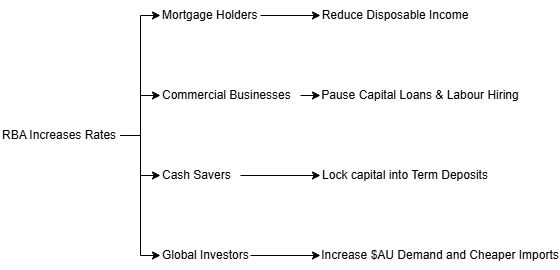
When you are sitting directly under the vent, it is easy to assume everyone else is enjoying a warm, comfortable room. But a thermostat change alters the climate of the entire house. The RBA’s cash rate sets the baseline price of money for the whole financial system, and as that price goes up, behavior changes in three distinct zones:
1. The Business Expansion Freeze
Just like a household budget, businesses rely on credit to grow. When the RBA raises the dial, commercial loans instantly become more expensive.
- The Reaction: That local manufacturing plant or tech startup that was planning to borrow $5 million to build a new warehouse or hire twenty new staff suddenly looks at the interest bill and says, “Not this year.”
- The Economic Impact: By forcing businesses to pause expansion, the RBA slows down hiring and reduces overall demand for raw materials and equipment. The corporate world catches a major chill.
2. The Incentive to Hoard Cash (The Savers’ Room)
For years, leaving money in a bank account felt like putting it under a mattress; you earned next to nothing. High interest rates completely flip that script.
- The Reaction: Suddenly, high-interest savings accounts and term deposits are offering 5% or more. If an investor or a wealthy household has $100,000 sitting around, they are no longer incentivized to risk it in the stock market or spend it on a new luxury car. They lock it away to collect guaranteed returns.
- The Economic Impact: This effectively vacuums active money right out of the economy. Instead of that cash circulating through retail stores, restaurants, and tourism, it sits frozen in a vault.
3. The International Currency Shield
We live in a global economy, and money flows wherever it can get the best return.
- The Reaction: When Australia’s interest rates rise relative to other countries, global investors want to move their capital into Australian banks to chase those higher yields. To do that, they have to buy Australian Dollars (AUD).
- The Economic Impact: This drives up the value of the AUD. A stronger dollar makes our imports, like cars, computers, and pharmaceuticals cheaper. It acts as an external shield, cooling down the global inflation we accidentally import at the docks.
The Global Currency Neighbourhood (The Mundell-Fleming Reality)
We like to think of our economy as an independent island, but financially, Australia is more like one house in a massive global street. And in that street, there is an invisible, unstoppable current called the Global Baseline Interest Rate.
This baseline is primarily controlled by the world’s financial heavyweights like the US Federal Reserve. Because the global economy is deeply interconnected and capital flows freely across borders, big global investors are constantly looking for the safest, highest-paying place to park their billions.
Here is how that reality forces the RBA’s hand:
- The Reality of Being a ‘Small Open Economy’: Australia is too small to dictate terms to global financial markets. If major central banks overseas raise their rates to say, 5%, and the RBA tries to keep Australian rates low at 3% to protect local mortgage holders, a massive chain reaction occurs.
- The Flight of Capital: Global investors, and even Australian super funds, will instantly pull their money out of Australian banks and move it overseas to chase those higher, safer returns.
- The Exchange Rate Collapse: To move that money out of the country, investors have to sell their Australian Dollars (AUD) and buy foreign currency. When everyone dumps the AUD, its value plummets.
Why a Crashing Currency Makes Life Worse
If the RBA lets the AUD crash just to save mortgage holders some pain, it triggers a different, more vicious kind of penalty for the whole country:
- Imported Inflation: Australia relies heavily on imports for everything from fuel and electronics to heavy machinery and cars. A weak currency makes everything we buy from overseas instantly more expensive.
- The Result: The price of petrol at your local bowser spikes, retail prices jump, and business costs skyrocket. The “heat” in our house goes up anyway, completely defeating the purpose of trying to keep rates low.
By lifting the local cash rate in lockstep with global trends, the RBA isn’t trying to be cruel. They are closing the front door of the house, to prevent the heat from the other houses coming inside, shielding the entire population from imported inflation.
The Hard Truth: Why We Can’t Just Turn Off the AC
It is completely valid to look at this entire system and feel a sense of deep frustration. If you have a mortgage, you are effectively being forced to sit directly under the freezing draft of the economic air conditioner, so the rest of the house doesn’t burn down. It feels unfair because the burden is inherently unequal.
But the alternative to this temporary chill is a permanent fire.
If the RBA chose to turn off the AC entirely by slashing interest rates to relieve mortgage holders while the economy was still running hot, then the consequences would ripple out to destroy everyone’s purchasing power equally.
When inflation gets locked into an economy, it changes from a temporary spike into a psychological trap:
- The Wage-Price Spiral: Workers demand higher pay to keep up with skyrocketing grocery bills. Businesses then raise prices to cover those higher wages. Around and around it goes.
- The Death of Savings: The money you worked hard to save quietly evaporates in value year after year.
- Economic Paralysis: When prices change by the week, businesses stop investing because they can’t predict their costs, and long-term economic growth grinds to a halt.
High interest rates are a painful, blunt, and deeply imperfect tool. They demand a heavy sacrifice from a single third of the country, the mortgage holders. But they are used because runaway inflation is a tax on 100% of the country, hitting the most vulnerable and those without assets the hardest.
The RBA isn’t adjusting the thermostat because they enjoy watching mortgage holders’ shiver. They are doing it because keeping the entire house from overheating is the only way to ensure we all still have a house to live in tomorrow.
Leave a Reply