
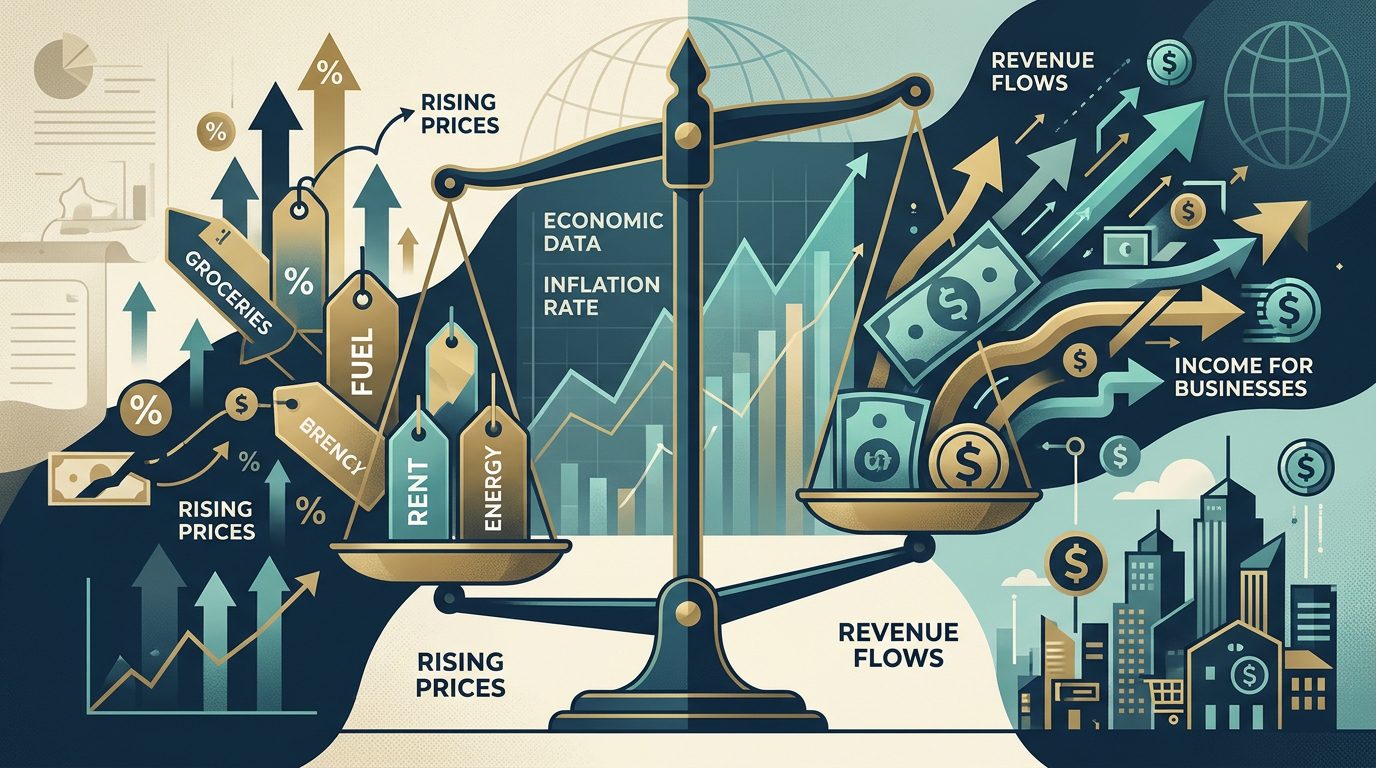
Understanding inflation means looking beyond who pays higher prices and asking who receives the money.
Over the past few days, we’ve explored inflation from several different angles.
We’ve looked at how global economic forces influence Australia’s inflation rate. We’ve examined why rising prices hit household budgets differently. And we’ve considered the role of the Reserve Bank of Australia and the difficult choices involved in bringing inflation under control.
These discussions usually focus on the people who lose when prices rise.
- Families paying more for groceries.
- Motorists facing higher fuel costs.
- Renters confronting rising housing expenses.
- Mortgage holders coping with higher interest rates.
These costs are real, and for many Australians they have become an unavoidable part of daily life.
But there is another side to the inflation story that receives far less attention.
If households are paying more for goods and services, someone is receiving that additional money.
So, when prices rise, who wins?
Every Price Increase Is Someone Else’s Income
At its simplest, inflation is a rise in the prices paid by consumers.
But every price paid by one person becomes income for somebody else.
- The money spent on a tank of petrol becomes revenue for service stations, fuel distributors and oil producers.
- The money spent on electricity becomes revenue for energy companies and network operators.
- The money spent on groceries becomes revenue for farmers, wholesalers, transport providers and supermarkets.
This simple fact is often overlooked in public debates.
We naturally focus on the cost because that is what households experience directly. But inflation is also a story about where money flows throughout the economy.
That does not automatically mean someone is profiting unfairly. It simply means that rising prices have both costs and beneficiaries.
Higher Prices Do Not Necessarily Mean Higher Profits
One of the biggest misconceptions about inflation is that businesses benefit whenever prices go up.
Many businesses face rising costs at the same time as their customers.
Consider a local café.
If coffee beans become more expensive, electricity prices rise, wages increase and rent goes up, the café may need to charge more simply to maintain its existing profit margin.
Customers pay more.
The listed price increases.
But the owner may not actually earn any additional profit.
The higher price merely reflects the higher cost of doing business.
The same principle applies across much of the economy.
Manufacturers face higher input costs.
Transport companies face higher fuel expenses.
Retailers face higher wage and operating costs.
Many price increases are simply the result of businesses attempting to recover those additional expenses.
This is why economists distinguish between rising prices and rising profits.
The two are not always the same thing.
Where the Debate Begins
The more interesting question is whether some firms can increase prices by more than their costs increase.
This is where economists, policymakers and commentators begin to disagree.
Economists generally agree that several factors contributed to the inflation surge that followed the pandemic. These included:
- Pandemic-related supply disruptions that constrained the supply of goods and services. [bis.org], [abs.gov.au]
- Higher global energy prices, particularly following major geopolitical conflicts that pushed up oil, gas and electricity costs. [rba.gov.au], [rba.gov.au]
- Tight labour markets and domestic capacity constraints that limited the economy’s ability to increase production. [rba.gov.au], [bis.org]
- International shipping bottlenecks and elevated freight costs that raised the price of imported goods. [rba.gov.au], [abs.gov.au]
- Strong demand following the pandemic recovery, supported by accumulated savings, fiscal support and historically low interest rates. [rba.gov.au], [rba.gov.au]
Under this explanation, businesses largely passed on unavoidable cost increases.
Another view argues that some firms used these disruptions as an opportunity to increase prices beyond what rising costs alone would justify.
In this argument, inflation created political and economic cover for larger profit margins.
Because consumers expected prices to rise, businesses found it easier to push through increases that may have been resisted under normal conditions.
This idea has become known as greedflation.
Why the Answer Matters
At first glance, this debate might seem like an academic argument.
It isn’t.
The causes of inflation directly influence the policies governments should pursue.
- If inflation is primarily caused by excessive demand, higher interest rates may help cool spending.
- If inflation is largely the result of global supply shocks, the effectiveness of higher interest rates becomes less clear.
- If market concentration or pricing power plays a significant role, competition policy may become part of the solution.
Understanding why prices have risen is essential because different causes require different responses.
Misidentifying the problem risks applying the wrong remedy.
Looking Beyond the Headlines
Public discussions about inflation often seek a single villain.
Governments blame global events.
Businesses point to rising costs.
Central banks focus on demand.
Workers highlight stagnant real wages.
The reality is usually more complicated.
Inflation is rarely caused by a single factor.
Instead, it emerges from the interaction of households, businesses, governments, global markets and central banks.
That complexity can be frustrating. Simple explanations are appealing because they are easy to understand.
Unfortunately, economics is rarely that simple.
The Question We’ll Explore Next
Over the past few days, we’ve looked at inflation through the perspectives of households, governments and central banks.
The next step is to examine the role of business profits.
Did firms simply pass on higher costs?
Did some industries use inflation as an opportunity to increase margins?
How much of Australia’s inflation can be explained by global shocks, and how much might be explained by market power?
These questions sit at the heart of the greedflation debate.
And before deciding whether greedflation is real, exaggerated or somewhere in between, we first need to understand exactly what the evidence says.