
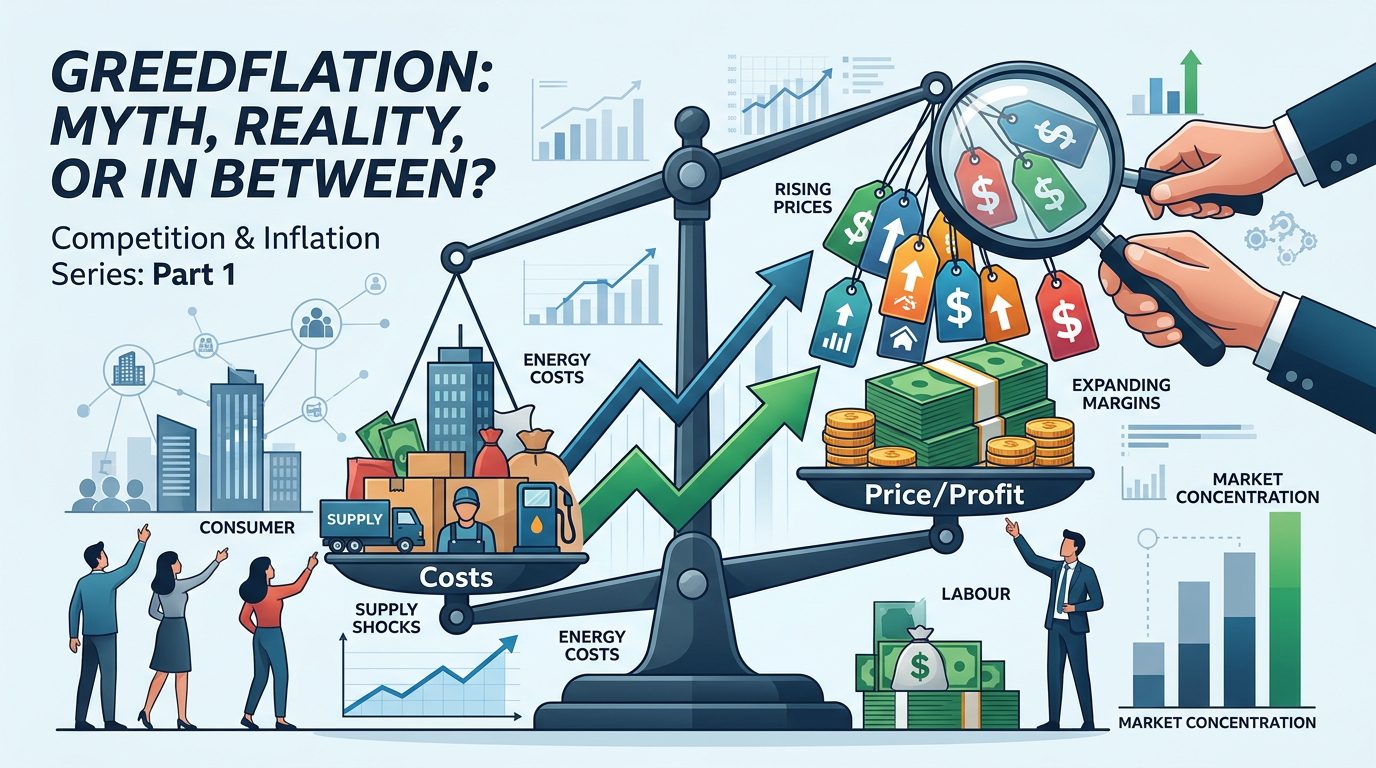
Part 1 of the Competition and Inflation Series
During Australia’s recent inflation surge, a new word entered the public debate: greedflation.
The idea was simple and appealing. Companies used rising costs, supply shortages and economic uncertainty as cover to increase prices beyond what was necessary, boosting profits while households struggled with higher grocery bills, insurance premiums and housing costs.
Many Australians found the argument persuasive. After all, prices were rising rapidly and some companies were reporting strong profits at the same time.
But does higher profitability necessarily mean greed caused inflation?
The answer is more complicated than either side of the debate often suggests.
What Is Greedflation?
Greedflation describes a situation where businesses increase prices by more than their costs increase, allowing profit margins to expand during an inflationary period.
The distinction is important.
Higher profits alone do not prove greedflation.
If a business experiences a 10% increase in costs and raises prices by 10%, its profit margin may remain largely unchanged. Profits might rise because revenue is higher, but profitability has not necessarily improved.
For greedflation to occur, something more must happen:
- Costs rise.
- Prices rise even more.
- Profit margins expand.
Several economists have developed theories explaining how this might occur during periods of economic disruption. Isabella M. Weber and Evan Wasner argue that supply shocks can create opportunities for firms with pricing power to raise prices in a coordinated way, even without formal collusion. Firms facing similar cost pressures may find it easier to increase prices when competitors are doing the same.
Why the Theory Became Popular
The greedflation debate emerged during an unusual period.
The global economy was hit by:
- Pandemic-related supply chain disruptions.
- Labour shortages.
- Surging shipping costs.
- Energy market disruptions following Russia’s invasion of Ukraine.
- Strong consumer demand following large fiscal stimulus programs.
These disruptions pushed inflation higher across much of the developed world. Australia was no exception. Inflation peaked at levels not seen for decades while households faced rapidly rising living costs. Statement on Monetary Policy – November 2026, Consumer Price Index, Australia September 2026, Consumer Price Index, Australia June 2021
As prices rose, many consumers noticed that some large companies were still reporting strong profits.
This raised a natural question: If costs are rising so much, why aren’t profits falling?
That question became the foundation of the greedflation debate.
The Economic Case for Greedflation
Recent academic research suggests inflationary environments can alter consumer behaviour in ways that increase pricing power.
According to Paul Scanlon, consumers may become less sensitive to individual price changes when inflation is already high. When prices are increasing throughout the economy, customers may find it harder to determine whether a particular price rise reflects genuine cost pressures or an individual firm’s pricing decisions.
Research by Viral V. Acharya and co-authors proposes a similar mechanism. Supply shocks initially create inflation, but rising inflation expectations can make consumers less responsive to price increases, allowing inflation to spread into sectors that were not directly affected by the original shock.
Under this framework:
- Supply shocks trigger inflation.
- Inflation expectations rise.
- Consumers become less price sensitive.
- Firms gain greater pricing power.
- Inflation spreads more broadly.
Importantly, this theory does not require business executives to become greedier. Instead, it suggests that inflation itself can create conditions that make price increases easier to sustain.
The Case Against Greedflation
Many economists remain sceptical that greedflation was a primary cause of the recent inflation surge.
Joseph E. Stiglitz and Ira Regmi argue that the dominant drivers of inflation were supply disruptions, energy shocks, changing consumption patterns and geopolitical events. Market power may have influenced how inflation spread, but they do not view corporate profits as the original cause.
Similarly, Florin O. Bilbiie and Diego R. Känzig argue that some popular greedflation narratives are difficult to reconcile with standard macroeconomic models. They note that inflation, profits and output can all rise together without profits necessarily causing inflation.
This highlights an important distinction.
A company can benefit from inflation without causing it.
For example:
- Energy producers may earn windfall profits when global commodity prices surge.
- Banks may become more profitable as interest rates rise.
- Insurers may benefit from premium increases.
These outcomes do not automatically prove that those industries caused inflation in the first place.
What Happened in Australia?
Australian evidence points toward a more nuanced explanation than either extreme position.
Research from the Reserve Bank of Australia suggests that weaker competition can amplify economic shocks by increasing firms’ pricing power. However, preliminary Australian evidence does not support the idea that broad-based profit expansion alone drove recent inflation.
The Australian Competition and Consumer Commission‘s supermarket inquiry found that Coles Group Limited and Woolworths Group Limited increased product margins and EBIT margins during the inflation period while maintaining dominant positions in grocery retailing.
Our analysis of listed Australian companies supports some of those findings.
Across the three major supermarket groups:
| Company | FY2019 EBIT Margin | Peak EBIT Margin |
| Coles Group Limited | 4.31% | 4.85% |
| Woolworths Group Limited | 4.54% | 4.90% |
| Metcash Limited | 2.60% | 3.21% |
The sector-average EBIT margin increased from approximately 3.8% before the inflation surge to 4.3% at its peak, an increase of around 0.5 percentage points.
That is evidence of margin expansion.
However, it is also important to keep the scale of the increase in perspective.
Average net profit margins across the major supermarket chains remained low and ultimately declined from around 2.6% in FY2019 to around 1.9% by FY2026.
The evidence suggests some expansion in operating profitability, but not an explosion in profits.
The More Important Question
One weakness of the greedflation debate is that it focuses on motives rather than market structure.
Businesses have always sought profits.
The executives running companies today are not inherently more profit-seeking than executives a decade ago.
The more relevant economic question is: Why were some firms able to raise prices more easily than others?
That leads directly to questions about:
- Market concentration.
- Barriers to entry.
- Consumer switching costs.
- Industry competition.
- Pricing power.
Research from Jonathan Hambur, Andrew Leigh, the Productivity Commission and the Treasury’s Competition Review all point toward declining competition as an increasingly important issue within parts of the Australian economy.
If inflation exposed a problem, it may not have been greed itself.
It may have been a lack of competitive pressure.
Conclusion
The evidence does not support the claim that corporate greed alone caused Australia’s recent inflation surge.
Supply disruptions, energy shocks, labour shortages and global events clearly played major roles.
At the same time, the evidence also suggests that some firms were able to expand margins during the inflation period, particularly in concentrated markets. Research indicates that inflationary conditions may have increased firms’ pricing power by making consumers less sensitive to price changes.
The result is a more nuanced conclusion.
Greedflation was probably not the primary cause of inflation.
But market power may have influenced how inflation spread through the economy once the initial shocks occurred.
The real debate is therefore not whether businesses seek profits.
They always do.
The more important question is whether Australia’s markets are competitive enough to stop them from exercising excessive pricing power when conditions allow.
In the next article, we’ll examine the issue that may matter more than greedflation itself: has Australia become too concentrated, with too much economic power resting in too few companies?
Leave a Reply