with Travis Nice

Tag: RBA

  • If Inflation Is Imported, Why Doesn’t the RBA Target the Exchange Rate?

    If Inflation Is Imported, Why Doesn’t the RBA Target the Exchange Rate?

    During the week, I wrote about interest rates, and inflation. Australia’s inflation strategy relies heavily on one tool: higher interest rates. But as imported inflation re-emerges, it may be time to ask whether another policy lever deserves a place in the conversation. Let’s discuss exchange rate intervention.

    Most Australians know how the Reserve Bank of Australia fights inflation.

    When prices rise too quickly, the RBA increases interest rates. Borrowing becomes more expensive, spending slows, and inflation eventually comes back under control. For decades, this has been the foundation of Australia’s inflation-fighting framework.

    But what if part of the inflation problem isn’t being caused by excessive domestic spending at all?

    What if rising prices are arriving from overseas?

    Australia imports a vast range of goods that households and businesses rely on every day. Fuel, vehicles, electronics, clothing, pharmaceuticals, and industrial machinery are all influenced by global prices and exchange-rate movements. Yet when inflation accelerates, policy discussions almost always focus on interest rates and rarely on the value of the Australian dollar itself. This raises an uncomfortable question:

    If a growing share of inflation is imported, should exchange-rate policy play a larger role in controlling it?

    Not All Inflation Is the Same

    Economists divide inflation into two broad categories: tradables and non-tradables.

    Tradables are goods and services exposed to international competition and global pricing. They include:

    • Fuel
    • Motor vehicles
    • Consumer electronics
    • Clothing and footwear
    • Household goods
    • International travel

    Their prices are heavily influenced by developments in global markets and movements in the Australian dollar. Non-tradables, by contrast, are largely produced and consumed domestically. They include:

    • Rent
    • Childcare
    • Education
    • Health services
    • Haircuts
    • Many local services

    Their prices are driven more by domestic factors such as wages, housing supply and local demand conditions. The distinction matters because different forms of inflation respond to different policy tools.

    Higher interest rates can reduce domestic demand. They have far less influence over the global price of oil or the cost of imported manufactured goods.

    Imported Inflation Is Rising Again

    The latest data from the Australian Bureau of Statistics show:

    Tradables inflation:4.0%
    Non-tradables inflation:4.5%
    Table 1: Source https://www.abs.gov.au/statistics/economy/price-indexes-and-inflation/consumer-price-index-australia/latest-release

    While domestic inflation remains slightly higher, the trend tells an important story.

    Tradables inflation has accelerated rapidly:

    YearTradables Inflation
    September 20240.6%
    September 20251.9%
    September 20264.0%
    Table 2: Source https://www.abs.gov.au/statistics/economy/price-indexes-and-inflation/consumer-price-index-australia/sep-2026/640101.xlsx

    Over the same period, non-tradables inflation has remained persistently elevated in the mid-4 per cent range.

    The gap between imported and domestic inflation has narrowed considerably.

    Fuel illustrates the point clearly.

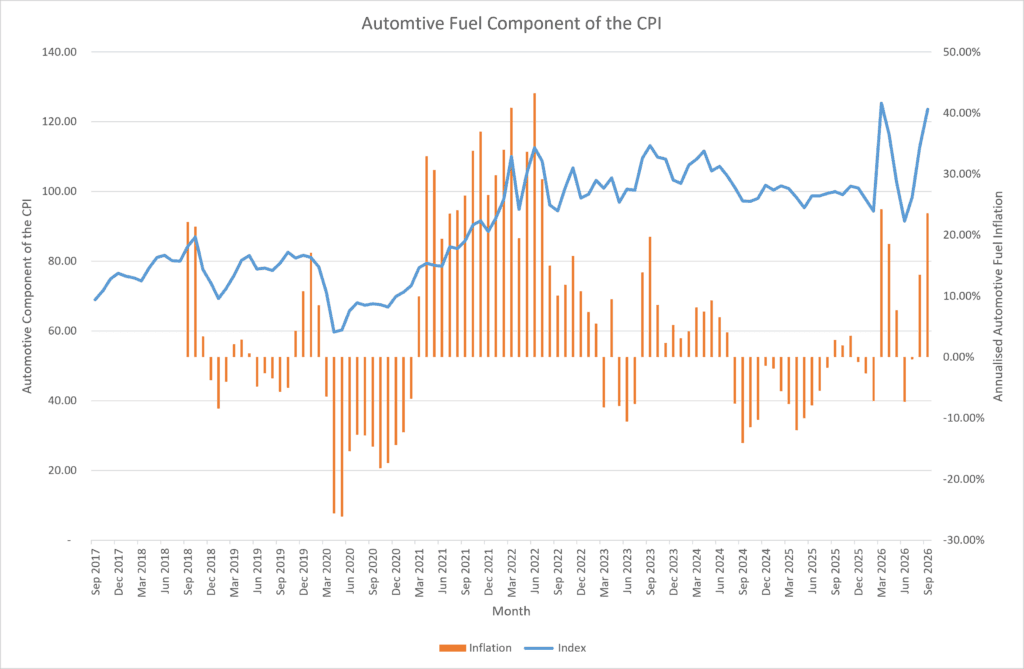
    Automotive fuel prices rose 23.6% over the year to September 2026, making them one of the largest contributors to inflation. Australians have little influence over global oil prices. But they do experience those prices through the lens of the exchange rate. Every time the Australian dollar weakens against the US dollar, imported fuel becomes more expensive in local currency terms.

    The Conventional Response

    When inflation rises, central banks typically respond by increasing interest rates.

    The logic is straightforward:

    1. Higher mortgage repayments reduce disposable income.
    2. Consumer spending slows.
    3. Business investment eases.
    4. Inflationary pressures gradually decline.

    This framework makes sense when inflation is being driven by excessive demand within the domestic economy. But imported inflation presents a different challenge.

    Higher mortgage repayments in Brisbane do not lower the global price of crude oil.

    Nor do they directly reduce the cost of imported vehicles, consumer electronics or industrial equipment.

    The policy works indirectly, suppressing demand across the broader economy to offset inflation originating elsewhere.

    The Tool We Rarely Discuss

    There is another channel through which inflation can be influenced:

    The exchange rate.

    A stronger Australian dollar reduces the local currency cost of imports.

    All else being equal, this means:

    • Cheaper fuel
    • Lower prices for imported consumer goods
    • Reduced costs for imported machinery and equipment
    • Lower input costs for businesses that rely on imported products

    In theory, a stronger currency targets tradable inflation directly. That leads to a simple question:

    If imported inflation is becoming more important, why is exchange-rate policy almost entirely absent from Australia’s inflation debate?

    Why the RBA Rarely Intervenes

    There are good reasons Australia generally avoids managing the exchange rate.

    Since the Australian dollar was floated in 1983, the Reserve Bank of Australia has viewed exchange-rate flexibility as an important economic shock absorber. A floating currency allows the economy to adapt to changing global conditions without requiring constant intervention from policymakers. The RBA still intervenes occasionally, but these operations are generally reserved for periods of market dysfunction rather than attempts to maintain a particular exchange-rate level. In fact, intervention has become far less common over time. There are also practical limitations.

    Foreign exchange markets are enormous. Even central banks can struggle to influence exchange rates for extended periods. Research on Australia’s experience suggests intervention can have an effect, but often only a modest one. A stronger dollar would also create winners and losers.

    Consumers would benefit from cheaper imports.

    Export industries, however, could face reduced competitiveness. Sectors such as:

    • Mining
    • Agriculture
    • Tourism
    • International education

    benefit from a weaker Australian dollar rather than a stronger one. There is no free lunch.

    Have We Become Too Reliant on Interest Rates?

    Perhaps the most interesting question is not whether foreign exchange intervention would work.

    It is whether Australia’s policy framework has become so focused on interest rates that alternative tools are no longer seriously considered.

    Modern economic management assigns clear roles:

    • Governments manage fiscal policy.
    • The RBA manages monetary policy.
    • The exchange rate floats freely.

    As a result, almost every inflation conversation eventually becomes a conversation about interest rates.

    Yet the latest inflation figures suggest imported inflation is once again becoming a meaningful contributor to rising prices. Tradables inflation has more than doubled over the past year and now sits only marginally below non-tradables inflation.

    At the very least, that should prompt a broader discussion about the available policy options.

    Conclusion

    The case for routine foreign exchange intervention is far from settled.

    Domestic inflation remains a significant challenge, and non-tradables inflation is still running above tradables inflation. Interest rates will remain the RBA’s primary policy tool for the foreseeable future. But imported inflation is no longer a trivial part of the story.

    Tradables inflation has accelerated sharply, fuel costs have surged, and exchange-rate movements continue to influence the price Australians pay for many of the goods they consume every day.

    Should a country that imports so much of what it consumes rely almost exclusively on one anti-inflation tool?

    The answer may ultimately be that exchange-rate intervention is ineffective, costly or economically damaging.

    But as imported inflation re-emerges, it is a debate worth having.

  • RBA Independence and the Accountability Gap in Inflation

    RBA Independence and the Accountability Gap in Inflation

    RBA independence may have created an accountability gap. Governments receive the political benefits of spending and tax decisions, while the RBA frequently bears the political cost of controlling their inflationary consequences.

    Most Australians know who to blame when mortgage repayments rise.

    The Reserve Bank raises interest rates, banks pass on the increase, and households immediately feel the impact. When inflation is high and borrowing costs are rising, public frustration often lands squarely on the Reserve Bank of Australia (RBA).

    But is the institution administering the pain always responsible for creating the conditions that made it necessary?

    Inflation is not determined by monetary policy alone. Government spending, taxation, budget deficits, labour market conditions, productivity growth and global economic shocks all influence inflation outcomes. Yet public debate frequently treats inflation management as though it rests solely with the RBA.

    This raises an important question: has Australia’s system of central-bank independence created an accountability gap?

    This is not an argument against an independent RBA. The Bank’s independence protects monetary policy from short-term political pressures and remains a cornerstone of Australia’s economic framework. Rather, the question is whether that framework concentrates public accountability on the RBA while reducing scrutiny of the fiscal decisions that can also influence inflation.

    History provides some compelling examples.

    Why RBA Independence Matters

    The RBA’s independence exists for good reason.

    Politicians face elections. Central bankers do not.

    Australia’s monetary policy framework gives the RBA responsibility for maintaining inflation between 2 and 3 per cent on average over time. The Bank is expected to make decisions that support long-term economic stability, even when those decisions are unpopular.

    The challenge is that inflation is rarely created by monetary conditions alone.

    Government budgets can either complement the RBA’s efforts or make its task more difficult. When fiscal and monetary policy are aligned, inflation control becomes easier. When they move in different directions, tensions can emerge.

    The following case studies examine periods when fiscal and monetary policy appeared to be pulling in opposite directions.

    Case Study 1: The Howard-Costello Budget and the RBA’s Inflation Fight (2006-2007)

    By 2007, Australia was enjoying the benefits of the mining boom. Economic growth was strong, unemployment was exceptionally low, and inflationary pressures were beginning to emerge.

    The Commonwealth Government acknowledged this reality in the 2007-08 Budget, noting that Australia was “as close to full employment as it has been for over 30 years” while also identifying capacity constraints within the economy. 1

    Despite these conditions, the Government announced approximately $31.5 billion in personal income tax reductions over four years. The Budget stated that these reforms would increase disposable incomes and support workforce participation. 2

    At the same time, the RBA was attempting to restrain inflation.

    In the Governor’s Foreword to the 2007 Annual Report, Glenn Stevens noted:

    “Monetary policy was tightened somewhat in the first half of the financial year and again in August 2007, as the Board acted to keep inflation close to the target.” 3

    This created a notable policy tension.

    While fiscal policy increased household disposable income, monetary policy sought to slow spending through higher borrowing costs.

    Reasonable observers may disagree about whether either institution made the wrong decision. However, it is difficult to deny that the two arms of macroeconomic policy were exerting pressure in different directions.

    For most Australians, the most visible consequence was not the tax relief announced in Budget Paper No. 1.

    It was the increase in their mortgage repayments.

    This highlights a recurring feature of economic policymaking: fiscal policy can contribute to inflationary conditions, but monetary policy is often the mechanism through which households experience the response.

    Case Study 2: Inflation, Interest Rates and Cost-of-Living Relief (2022-2024)

    Australia’s post-pandemic inflation surge presented policymakers with one of the most difficult economic environments in decades.

    Inflation rose to levels not seen for a generation. Supply-chain disruptions, labour shortages, strong consumer demand and rising energy prices all contributed to sustained price pressures.

    The RBA responded with one of the fastest interest-rate tightening cycles in modern Australian history.

    By May 2024, the Bank remained concerned about inflation. It stated that inflation was “falling more gradually than expected” and emphasised that returning inflation to target remained its highest priority 4. The Bank also stated that higher interest rates were expected to bring demand into better balance with supply and noted that aggregate demand remained above the economy’s productive capacity 5.

    At the same time, governments faced intense political pressure to relieve cost-of-living pressures.

    The Commonwealth’s 2024-25 Budget included:

    • Energy bill relief;
    • Increases to Commonwealth Rent Assistance;
    • Personal income tax changes;
    • Other targeted household support measures. 6

    Importantly, the Government did not present these measures as inflationary stimulus. Instead, it argued they would help reduce inflation while providing household relief. The Budget specifically stated that cost-of-living measures would lower headline inflation in the near term. 7

    The available evidence suggests that at least some measures achieved that objective.

    The RBA estimated that government electricity rebates reduced headline inflation by around 0.3 percentage points in the March quarter of 2024. 8

    However, the same RBA documents also observed that public spending continued to support economic activity and that overall demand remained stronger than the economy’s supply capacity. 9

    This reveals a more nuanced tension than the 2007 example.

    The Government sought to shield households from rising living costs. The RBA sought to bring inflation back to target. Both objectives were defensible. Yet they operated through different channels and potentially created competing effects.

    What happened politically is perhaps more interesting.

    Media coverage focused overwhelmingly on:

    • Interest-rate decisions;
    • Mortgage stress;
    • Statements from the RBA Governor;
    • Predictions of future rate increases.

    Far less attention was given to the interaction between fiscal and monetary policy.

    As a result, the institution delivering the most visible economic pain became the focal point of public frustration, even though inflation was being shaped by a much broader combination of fiscal decisions, monetary policy and external economic forces.

    The Accountability Gap

    These episodes reveal an asymmetry at the heart of Australia’s policy framework.

    Governments receive political credit for:

    • Tax cuts;
    • Rebates;
    • Infrastructure projects;
    • Cost-of-living support.

    The benefits are visible and easy to communicate.

    The RBA, by contrast, often bears political responsibility for:

    • Higher mortgage repayments;
    • Slower economic activity;
    • Reduced borrowing capacity;
    • Falling asset prices.

    The costs are immediate and highly visible to households.

    This creates a situation where one institution frequently delivers the benefits while another delivers the pain.

    That does not mean governments deliberately use the RBA as a scapegoat.

    A more evidence-based conclusion is that the design of Australia’s institutions may create an accountability gap. The public naturally focuses on the decision-maker most visibly affecting household finances, even when the underlying economic outcomes result from a broader mix of fiscal and monetary policies.

    Conclusion

    Public debate often frames economic management as a story about the Reserve Bank.

    But inflation is not created by the RBA, nor can it be controlled by the RBA alone.

    Economic outcomes emerge from the combined effects of government budgets, taxation, spending decisions, monetary policy and global economic forces.

    The experiences of 2007 and 2022-24 illustrate that fiscal and monetary policy do not always move in the same direction. When they do not, public attention tends to focus on the institution that raises interest rates because its actions are immediate and painful.

    Perhaps the more important question is not whether the RBA receives too much scrutiny.

    It is whether elected governments receive enough.

    1. Australian Government, Budget Paper No. 1: Budget Strategy and Outlook 2007-08, Statement 3: Economic Outlook, p.5 ↩︎
    2. Australian Government, Budget Paper No. 1: Budget Strategy and Outlook 2007-08, Statement 1: Fiscal Strategy and Budget Priorities, p.8 ↩︎
    3. Reserve Bank of Australia, Annual Report 2007, p. 3. ↩︎
    4. Reserve Bank of Australia, Statement on Monetary Policy, May 2024, p.1 ↩︎
    5. Reserve Bank of Australia, Statement on Monetary Policy, May 2024, p.1, 3, 31 ↩︎
    6. Australian Government, Budget Paper No. 1: Budget Strategy and Outlook 2024-25, pp.8-38 ↩︎
    7. Australian Government, Budget Paper No. 1: Budget Strategy and Outlook 2024-25, p.50 ↩︎
    8. Reserve Bank of Australia, Statement on Monetary Policy, May 2024, p.34 ↩︎
    9. Reserve Bank of Australia, Statement on Monetary Policy, May 2024, p.19, 25, 31 ↩︎

  • Why Your Power Bill and Petrol Tank Matter More Than the Inflation Rate

    Why Your Power Bill and Petrol Tank Matter More Than the Inflation Rate

    Last week, I explained why the Reserve Bank of Australia keeps interest rates high and why mortgage holders often feel like they’re carrying the burden of the fight against inflation.

    During the week, the latest inflation figures from the Australian Bureau of Statistics (ABS) help answer an important follow-up question:

    What exactly is becoming more expensive, and why does inflation still feel painful despite years of interest rate rises?

    The answer is simple.

    Most Australians don’t experience inflation through percentages and economic reports. They experience it through the bills they pay every week.

    And right now, some of the biggest pressures are coming from housing, electricity, and fuel.

    The Inflation Rate Doesn’t Tell the Whole Story

    The headline inflation rate sits at 4.3%, meaning that, on average, prices are 4.3% higher than they were a year ago.

    But nobody buys the “average basket” measured by the ABS.

    Instead, households spend money on:

    • Housing
    • Electricity
    • Fuel
    • Groceries
    • Insurance
    • Healthcare

    The impact of inflation depends on which of these expenses are increasing the fastest.

    A family that spends heavily on categories experiencing rapid price growth will feel much more pressure than the headline figure suggests.

    Housing Remains the Biggest Pressure Point

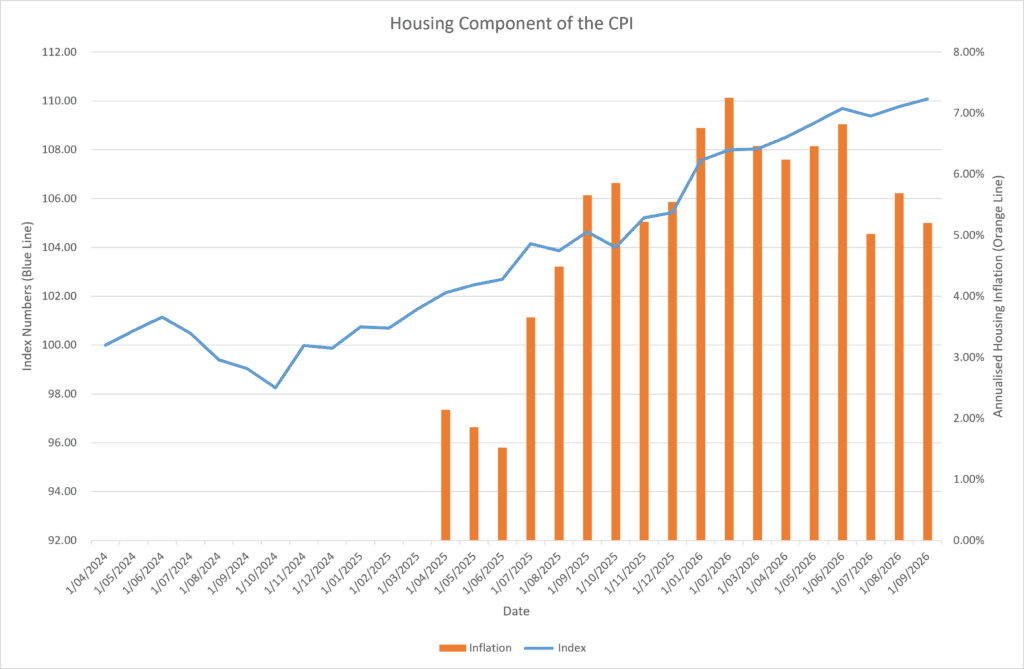
    According to the ABS, housing costs increased by 5.2% over the past year, making housing one of the largest contributors to inflation. This includes costs associated with building new homes and maintaining housing supply.

    For homeowners, this comes on top of elevated mortgage repayments caused by higher interest rates.

    For renters, rising housing costs eventually work their way into rent increases as landlords face higher costs of their own.

    This creates an uncomfortable reality:

    Whether you own your home or rent it, housing continues to absorb a growing share of household income.

    Electricity Bills Are Climbing Again

    Many Australians can postpone replacing a television or buying new furniture.

    They cannot postpone paying the electricity bill.

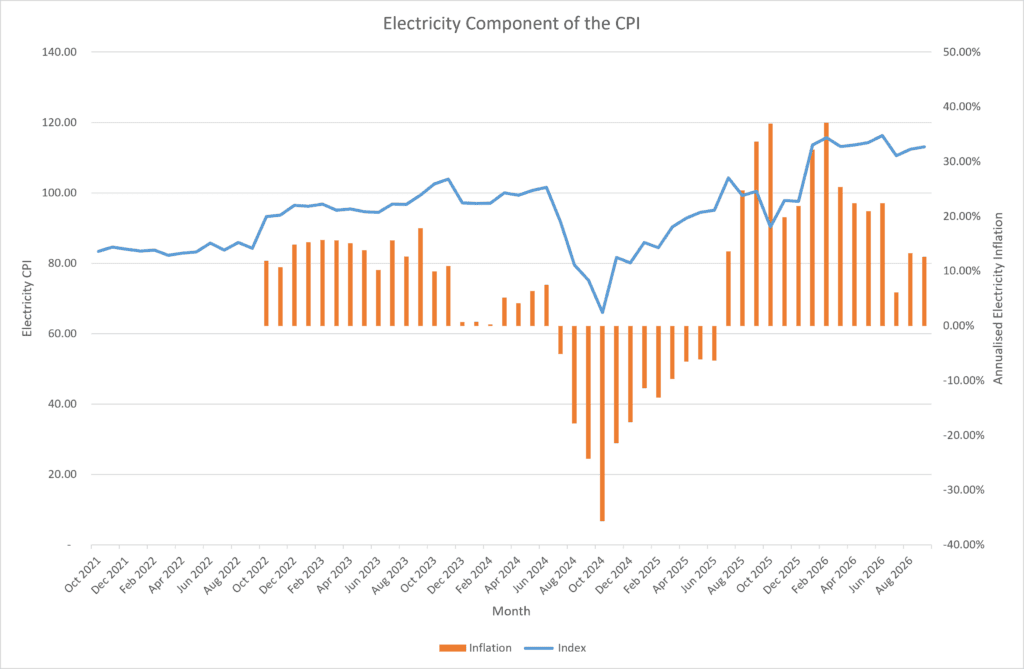
    The ABS reports that electricity prices have increased by 12.8% over the past year.

    Consider a household spending $250 per month on electricity.

    A 12.8% increase lifts that bill to approximately $282 per month.

    That may not sound dramatic, but over a year it adds roughly $380 to the household budget without delivering any additional benefit.

    You are paying more simply to consume the same amount of electricity.

    Petrol Is Quietly Taking a Bigger Bite Out of Household Budgets

    A chart of ABS data showing the Automotive Fuel Component of the CPI and its Annualised Inflation.
    Automotive Fuel Component of the CPI and its Annualised Inflation.

    Perhaps the most significant increase has been fuel.

    The ABS reports that automotive fuel prices have risen by 23.6% over the past year, including a substantial rise during September alone.

    For many Australians, particularly those living in suburban or regional areas, driving is not optional.

    A household spending $100 per week on petrol last year would now be spending approximately $124 per week.

    Over the course of a year, that’s an increase of more than $1,200.

    Unlike discretionary spending, there is often little opportunity to avoid these costs. People still need to commute to work, take children to school, and travel for essential activities.

    Why the RBA Still Worries About Inflation

    This helps explain why the Reserve Bank remains cautious about reducing interest rates.

    When households hear that inflation is “only” 4.3%, it is easy to think the problem has largely been solved.

    But inflation is not yet back within the RBA’s target range of 2% to 3%.

    More importantly, some of the biggest increases are occurring in essential categories that households cannot easily avoid.

    If the RBA were to cut rates too early and inflation accelerated again, the cost of housing, electricity, fuel, and other necessities could rise even faster.

    That would ultimately leave households worse off.

    The Real Cost of Inflation

    The most important lesson from the latest inflation figures is that inflation is not an abstract economic concept.

    It is the extra amount you pay every time you:

    • Receive an electricity bill.
    • Fill up your car.
    • Pay your rent.
    • Make a mortgage repayment.
    • Buy groceries.

    While headlines focus on a single inflation number, household budgets are affected by the prices that matter most in everyday life.

    And right now, those essentials are still becoming more expensive.

    That’s why many Australians continue to feel financially squeezed, even after years of interest rate rises. The fight against inflation may be working, but for many households, it certainly doesn’t feel over yet.

  • Unfair or Unavoidable? How the Global Market Dictates Our Interest Rates

    Unfair or Unavoidable? How the Global Market Dictates Our Interest Rates

    If you hold a mortgage, it probably feels like the Reserve Bank of Australia has a personal grudge against you. Every time they increase the cash rate, your disposable income takes a direct hit. And it is entirely reasonable to feel like they are targeting you to solve a national problem.

    But the cash rate isn’t like a laser pointer aimed at your home loan. It is more like the thermostat to an air conditioner in a massive Australia sized house. And right now, the Australian economy is overheating.

    Think of the entire country as a giant house. Over the last few years, everyone was moving around, working hard, and we all generated a lot of heat. Businesses were hiring frantically, global supply chains changed, and consumer spending surged. The economic temperature skyrocketed, and that blazing heat is what we call inflation. It devalues your savings, drives up the cost of groceries, and makes everything unlivable.

    To fix this, the RBA has to turn on the air conditioner to cool the house back down to a comfortable 2% to 3% target zone.

    The catch? The RBA only has one thermostat dial, the cash rate, and the vents to that air conditioner aren’t evenly distributed. Mortgage holders happen to be sitting directly underneath the main vent. You are feeling the icy blast first, and it freezes your budget.
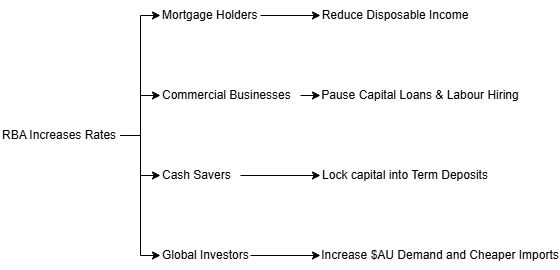
    But while you are shivering under that vent, the cold air is quietly moving through the rest of the house. Higher rates mean commercial banks stop handing out cheap money, businesses put massive expansion plans on ice, and savers suddenly lock their cash away in high-yield accounts rather than spending it. The thermostat is adjusting the climate for everyone. Mortgage holders just happen to be on the front line of the breeze.

    How the Chill Spreads Beyond the Living Room

    When you are sitting directly under the vent, it is easy to assume everyone else is enjoying a warm, comfortable room. But a thermostat change alters the climate of the entire house. The RBA’s cash rate sets the baseline price of money for the whole financial system, and as that price goes up, behavior changes in three distinct zones:

    1. The Business Expansion Freeze

    Just like a household budget, businesses rely on credit to grow. When the RBA raises the dial, commercial loans instantly become more expensive.

    • The Reaction: That local manufacturing plant or tech startup that was planning to borrow $5 million to build a new warehouse or hire twenty new staff suddenly looks at the interest bill and says, “Not this year.”
    • The Economic Impact: By forcing businesses to pause expansion, the RBA slows down hiring and reduces overall demand for raw materials and equipment. The corporate world catches a major chill.

    2. The Incentive to Hoard Cash (The Savers’ Room)

    For years, leaving money in a bank account felt like putting it under a mattress; you earned next to nothing. High interest rates completely flip that script.

    • The Reaction: Suddenly, high-interest savings accounts and term deposits are offering 5% or more. If an investor or a wealthy household has $100,000 sitting around, they are no longer incentivized to risk it in the stock market or spend it on a new luxury car. They lock it away to collect guaranteed returns.
    • The Economic Impact: This effectively vacuums active money right out of the economy. Instead of that cash circulating through retail stores, restaurants, and tourism, it sits frozen in a vault.

    3. The International Currency Shield

    We live in a global economy, and money flows wherever it can get the best return.

    • The Reaction: When Australia’s interest rates rise relative to other countries, global investors want to move their capital into Australian banks to chase those higher yields. To do that, they have to buy Australian Dollars (AUD).
    • The Economic Impact: This drives up the value of the AUD. A stronger dollar makes our imports, like cars, computers, and pharmaceuticals cheaper. It acts as an external shield, cooling down the global inflation we accidentally import at the docks.

    The Global Currency Neighbourhood (The Mundell-Fleming Reality)

    We like to think of our economy as an independent island, but financially, Australia is more like one house in a massive global street. And in that street, there is an invisible, unstoppable current called the Global Baseline Interest Rate.

    This baseline is primarily controlled by the world’s financial heavyweights like the US Federal Reserve. Because the global economy is deeply interconnected and capital flows freely across borders, big global investors are constantly looking for the safest, highest-paying place to park their billions.

    Here is how that reality forces the RBA’s hand:

    • The Reality of Being a ‘Small Open Economy’: Australia is too small to dictate terms to global financial markets. If major central banks overseas raise their rates to say, 5%, and the RBA tries to keep Australian rates low at 3% to protect local mortgage holders, a massive chain reaction occurs.
    • The Flight of Capital: Global investors, and even Australian super funds, will instantly pull their money out of Australian banks and move it overseas to chase those higher, safer returns.
    • The Exchange Rate Collapse: To move that money out of the country, investors have to sell their Australian Dollars (AUD) and buy foreign currency. When everyone dumps the AUD, its value plummets.

    Why a Crashing Currency Makes Life Worse

    If the RBA lets the AUD crash just to save mortgage holders some pain, it triggers a different, more vicious kind of penalty for the whole country:

    • Imported Inflation: Australia relies heavily on imports for everything from fuel and electronics to heavy machinery and cars. A weak currency makes everything we buy from overseas instantly more expensive.
    • The Result: The price of petrol at your local bowser spikes, retail prices jump, and business costs skyrocket. The “heat” in our house goes up anyway, completely defeating the purpose of trying to keep rates low.

    By lifting the local cash rate in lockstep with global trends, the RBA isn’t trying to be cruel. They are closing the front door of the house, to prevent the heat from the other houses coming inside, shielding the entire population from imported inflation.

    The Hard Truth: Why We Can’t Just Turn Off the AC

    It is completely valid to look at this entire system and feel a sense of deep frustration. If you have a mortgage, you are effectively being forced to sit directly under the freezing draft of the economic air conditioner, so the rest of the house doesn’t burn down. It feels unfair because the burden is inherently unequal.

    But the alternative to this temporary chill is a permanent fire.

    If the RBA chose to turn off the AC entirely by slashing interest rates to relieve mortgage holders while the economy was still running hot, then the consequences would ripple out to destroy everyone’s purchasing power equally.

    When inflation gets locked into an economy, it changes from a temporary spike into a psychological trap:

    • The Wage-Price Spiral: Workers demand higher pay to keep up with skyrocketing grocery bills. Businesses then raise prices to cover those higher wages. Around and around it goes.
    • The Death of Savings: The money you worked hard to save quietly evaporates in value year after year.
    • Economic Paralysis: When prices change by the week, businesses stop investing because they can’t predict their costs, and long-term economic growth grinds to a halt.

    High interest rates are a painful, blunt, and deeply imperfect tool. They demand a heavy sacrifice from a single third of the country, the mortgage holders. But they are used because runaway inflation is a tax on 100% of the country, hitting the most vulnerable and those without assets the hardest.

    The RBA isn’t adjusting the thermostat because they enjoy watching mortgage holders’ shiver. They are doing it because keeping the entire house from overheating is the only way to ensure we all still have a house to live in tomorrow.