

Part 2 of the Australia’s Productivity Puzzle series
In the previous article, we examined a puzzle visible in Australia’s economic data.
The economy has continued to grow, yet GDP per capita has risen much more slowly than many Australians might expect. While total economic output has expanded, the gains available to each person have become harder to see.
To understand why this matters, we need to examine a concept that economists regard as one of the most important determinants of long-run prosperity: productivity.
Productivity rarely attracts public attention. It lacks the urgency of inflation, unemployment or interest rates. Yet when economists discuss rising living standards, stronger wages and future prosperity, productivity is usually at the centre of the conversation.
There is a reason for this.
As economist Paul Krugman famously observed:
“Productivity isn’t everything, but in the long run it is almost everything.”1
What Is Productivity?
At its simplest, productivity measures how efficiently an economy converts inputs into outputs.
Economists use several productivity measures, but labour productivity is among the most common. Labour productivity measures the amount of output produced for each hour worked.2
Imagine two workers performing the same task.
Both work eight hours each day.
One produces ten units of output.
The other produces fifteen.
The second worker is more productive because more value is created from the same amount of labour.
The same idea applies across businesses, industries and entire economies.
When productivity rises, workers and firms can generate more output without requiring proportionately more hours, people or resources.
Importantly, productivity is not about working harder.
It is about working more effectively.
Where Productivity Growth Comes From
Productivity growth can occur in many ways.
Better Technology
New technologies allow businesses to produce more output using fewer inputs.
The mechanisation of agriculture, industrial automation and modern computing all increased productivity dramatically.
Today, artificial intelligence is frequently discussed as the next major productivity-enhancing technology.
Better Skills
Workers who gain education, training and experience often become more productive over time.
A skilled electrician can typically complete work more efficiently than an apprentice. A highly experienced software engineer can often solve problems faster than a new graduate.
Investment in human capital can therefore become a source of productivity growth.
Better Capital
Workers are generally more productive when they have access to better tools, equipment and infrastructure.
A builder with modern machinery can achieve more in a day than a builder relying entirely on manual labour.
Similarly, businesses become more productive when they invest in machinery, software, transport infrastructure and other productive assets.
Better Organisation
Businesses often improve productivity simply by changing how work is organised.
Supply-chain management, logistics systems, inventory controls and management practices can all increase output without requiring additional labour.
Many productivity gains occur not because of technological breakthroughs, but because firms learn to use existing resources more effectively.
Why Productivity Matters for Living Standards
This brings us to the central reason economists care about productivity.
Living standards cannot increase indefinitely through longer working hours.
There are only so many hours people can work each week.
Instead, sustained increases in living standards depend on producing more value from the resources available.²
When productivity rises, societies gain more economic output from the same amount of labour and capital.
That additional output can be distributed in several ways:
- Higher wages for workers.
- Higher profits for businesses.
- Lower prices for consumers.
- Higher tax revenues that fund public services.
The precise distribution depends on market conditions and institutions, but productivity growth increases the total amount available to distribute in the first place.
Without productivity growth, improving living standards becomes much more difficult.
Australia’s Productivity Record
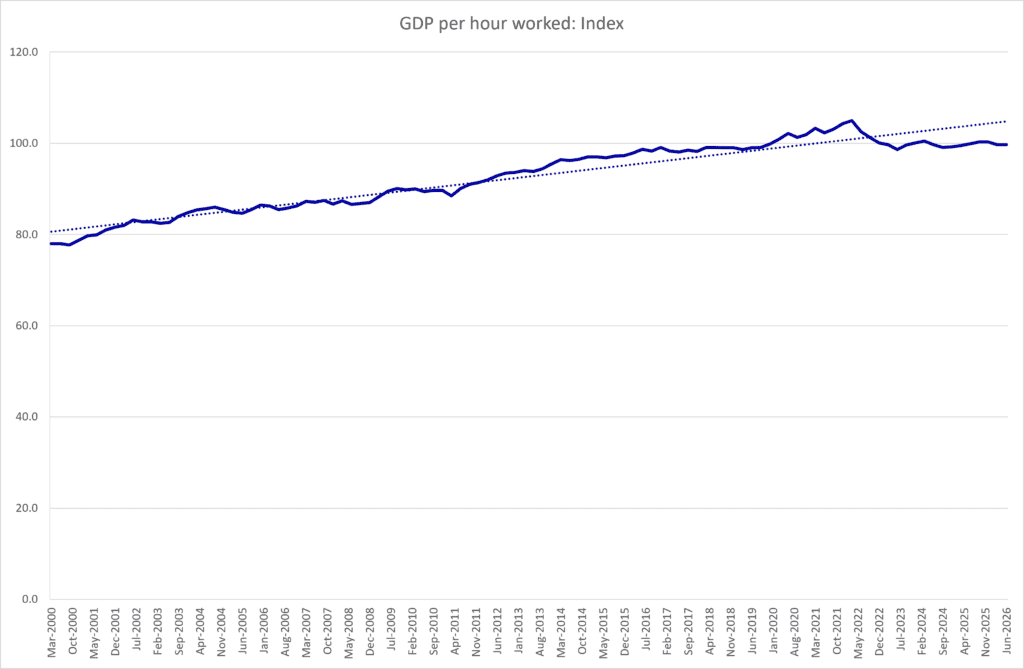
Historically, productivity growth has been one of the primary drivers of rising Australian living standards.²
Periods of strong productivity growth have generally coincided with stronger income growth and improvements in material prosperity.
However, Australia’s productivity performance has not been consistent over time.
During the 1990s, productivity growth accelerated significantly, supported by a combination of economic reforms, technological adoption and greater competition across many industries.
More recently, productivity growth has slowed.
Output per hour worked has continued to increase over the long run, but at a slower pace than during earlier decades. At the same time, GDP per capita growth has weakened, particularly since the early 2010s.
This matters because even small differences in annual productivity growth accumulate over time.
An economy growing productivity by 2 per cent per year will become dramatically more prosperous over a generation than one growing productivity by only 1 per cent.
The effects may seem modest in any given year, but they compound over decades.
The Question Australia Must Answer
If productivity is the foundation of long-run prosperity, Australia’s recent experience presents a challenge.
Why has productivity growth slowed?
Has technological progress become less effective?
Are businesses investing less?
Has competition weakened?
Or are labour and capital being allocated less efficiently across the economy?
These questions sit at the heart of Australia’s productivity debate.
They will also determine whether future generations experience the same improvements in living standards enjoyed by earlier Australians.
In the next article, we’ll examine when Australia’s productivity slowdown began, and why the answer predates both the pandemic and the recent cost-of-living crisis.
Endnotes
- Krugman, P. R. (1994). The age of diminished expectations: U.S. economic policy in the 1990s (3rd. ed.). MIT Press. ↩︎
- D’Arcy, P., & Gustafsson, L. (2012). Australia’s productivity performance and real incomes. Reserve Bank of Australia Bulletin, June 2012, 13-23. https://www.rba.gov.au/publications/bulletin/2012/jun/3.html ↩︎
Leave a Reply