
Part 4 of the Competition and Inflation Series
In previous articles, we examined the debate around greedflation, explored Australia’s competition challenges, and analysed the financial statements of 12 major Australian companies.
The evidence suggested something important: Not all industries experienced inflation in the same way.
Some sectors expanded margins. Others benefited from external shocks. Some saw profitability improve without corresponding revenue growth.
This article takes a closer look at three industries that affect almost every Australian household:
- Supermarkets
- Banks
- Insurers
All three experienced rising prices during the inflation period.
But did they exercise pricing power in the same way?
The financial statements suggest the answer is no.
What Is Pricing Power?
Pricing power is a firm’s ability to raise prices without losing a significant number of customers.
A business with strong pricing power can often:
- Pass on rising costs.
- Protect profit margins.
- Increase prices without significant reductions in demand.
Pricing power can arise from several factors:
- Strong brands.
- Limited competition.
- High switching costs.
- Regulatory barriers.
- Market concentration.
During periods of high inflation, pricing power becomes particularly important because firms face constant decisions about how much of their higher costs to pass on to customers.
Supermarkets: Margin Expansion, But Not an Explosion
No industry attracted more public criticism during Australia’s cost-of-living crisis than supermarkets.
The Australian Competition and Consumer Commission‘s supermarket inquiry found that Coles Group Limited and Woolworths Group Limited increased product margins and EBIT margins while maintaining dominant market positions.
Our analysis of the three major listed supermarket groups broadly supports that finding.
EBIT Margins
| Year | Coles | Woolworths | Metcash | Sector Average |
| FY2019 | 4.31% | 4.54% | 2.60% | 3.82% |
| FY2024 | 4.85% | 4.90% | 3.21% | 4.32% |
| FY2026 | 4.58% | 3.36% | 2.92% | 3.62% |
Financial statement analysis shows that supermarket operating profitability increased during the inflation period. The sector-average EBIT margin rose from approximately 3.8% to 4.3% at its peak.
That increase is real.
But it is also relatively modest.
The increase was roughly half a percentage point, not the several-percentage-point jump that many people imagine when discussing profiteering.
Net Profit Margins
The picture becomes even more restrained when examining net profits.
| Year | Sector Average Net Margin |
| FY2019 | 2.62% |
| FY2024 | 2.42% |
| FY2026 | 1.85% |
Rather than surging higher, average net margins eventually declined.
These remain characteristic of a low-margin retail industry.
Revenue Growth
Using ABS inflation data, cumulative inflation over the period was approximately 24.6%. [abs.gov.au], [abs.gov.au], [rba.gov.au]
After adjusting for inflation:
| Company | Real Revenue Growth |
| Metcash Limited | +9.6% |
| Woolworths Group Limited | -4.4% |
| Coles Group Limited | -6.1% |
The evidence suggests supermarkets did increase operating margins, consistent with the ACCC’s findings. However, the sector does not appear to have experienced exceptional inflation-adjusted revenue growth.
Banking: Benefiting From Higher Interest Rates
The banking sector presents a very different story.
Unlike supermarkets, banks benefit directly from changes in interest rates.
As the Reserve Bank of Australia increased rates to combat inflation, banks gained opportunities to improve lending margins and earnings.
Return on Equity
| Bank | Pre-Inflation ROE | Peak/Post-Inflation ROE |
| Commonwealth Bank of Australia | 10.85% | 14.62% |
| ANZ Group Holdings Limited | 7.59% | 10.53% |
| National Australia Bank Limited | 7.32% | 12.23% |
| Westpac Banking Corporation | 4.56% | 9.96% |
Every major bank experienced a significant improvement in returns.
Unlike supermarkets, the banking sector clearly became more profitable during the rate-tightening cycle.
Revenue Growth
The picture changes somewhat when examining income growth.
For example:
- Westpac Banking Corporation’s operating income increased from approximately $21.7 billion to $22.2 billion across the period.
- After adjusting for inflation, this represented a decline in real revenue.
This suggests that improved profitability came primarily from balance-sheet dynamics and interest-rate changes rather than extraordinary revenue growth.
Pricing Power or Interest Rate Cycle?
The evidence points toward a more nuanced interpretation.
Bank profitability improved.
However, that improvement appears consistent with how banking profitability typically responds to rising interest rates.
In other words, banks benefited from monetary policy tightening, but the evidence is not as straightforward as simply concluding they exercised excessive pricing power.
Insurance: The Quiet Profitability Story
While public attention was focused on supermarkets, insurers may have experienced some of the strongest profitability improvements in the dataset.
Yet insurers received relatively little scrutiny compared to grocery retailers.
Return on Equity
| Company | Early Period ROE | Peak ROE |
| Insurance Australia Group Limited | 3.17% | 17.45% |
| Suncorp Group Limited | 5.68% | 12.15% |
| QBE Insurance Group Limited | 9.44% | 17.59% |
All three major insurers show substantial increases in profitability.
That is not a coincidence.
Why Did Insurers Become More Profitable?
The explanation is more complicated than simply raising premiums.
Insurers faced significant cost pressures, including:
- Severe weather events.
- Higher catastrophe claims.
- Increasing reinsurance costs.
- Inflation in building and repair costs.
These factors justified premium increases across much of the sector.
However, the financial statements also show profitability recovering strongly as premium growth outpaced earlier periods.
This does not prove excessive pricing.
But it does suggest the insurance sector deserves at least as much attention in discussions of pricing power as supermarkets.
Comparing the Three Sectors
The data reveals three very different versions of pricing power.
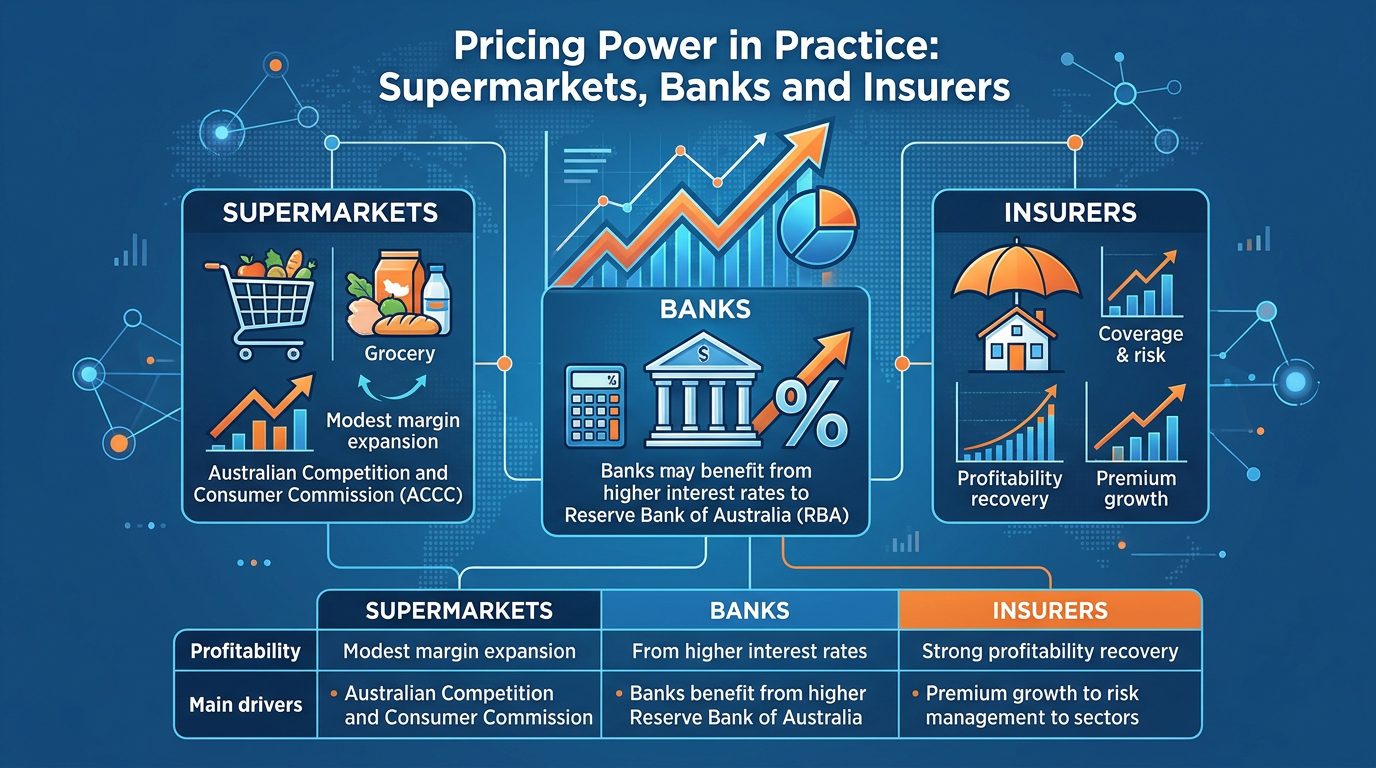
| Sector | Profitability Outcome | Main Driver |
| Supermarkets | Modest margin expansion | Market position and cost pass-through |
| Banks | Improved returns | Higher interest rates |
| Insurance | Strong profitability recovery | Premium growth and risk repricing |
The common thread is not greed. It is pricing power.
But the source of that pricing power differs across industries.
- Supermarkets rely on scale, networks and market position.
- Banks benefit from financial market structure and monetary policy.
- Insurers operate in markets with high switching costs and complex pricing decisions.
The mechanisms are different even when the outcome is similar.
What This Means for the Competition Debate
One lesson from the inflation period is that discussions of corporate profits often oversimplify a much more complex reality.
The question is rarely: Did companies seek profits?
Businesses always seek profits.
The more useful question is: Under what market conditions were firms able to protect or expand profitability?
The answer varies by industry.
Competition matters.
Industry structure matters.
Consumer choice matters.
And understanding those factors is far more important than assuming all sectors behaved the same way.
Conclusion
The financial statements suggest that pricing power existed across several parts of the Australian economy during the inflation period, but it manifested differently in different sectors.
Supermarkets increased operating margins, though only modestly. Banks benefited from rising interest rates. Insurers experienced significant profitability improvements as premiums increased and risk was repriced.
The lesson is that market structure shaped who could respond most effectively when inflation arrived.
In the final article of this series, we’ll examine whether stronger competition could help reduce inflationary pressures in the future, and what reforms policymakers are considering to make Australian markets more competitive.
Leave a Reply