
Part 4 of the Series: Interest Rates: The Most Important Price in the Economy
When the Reserve Bank raises interest rates, the public reaction is usually predictable.
Mortgage holders worry about rising repayments. Businesses complain about higher borrowing costs. Politicians debate the impact on household budgets. News headlines often focus on financial pain.
It’s easy to see why.
Higher interest rates increase the cost of borrowing, reduce spending power and place pressure on many households. Yet if higher interest rates were simply harmful, central banks would never raise them.
The reality is more complicated.
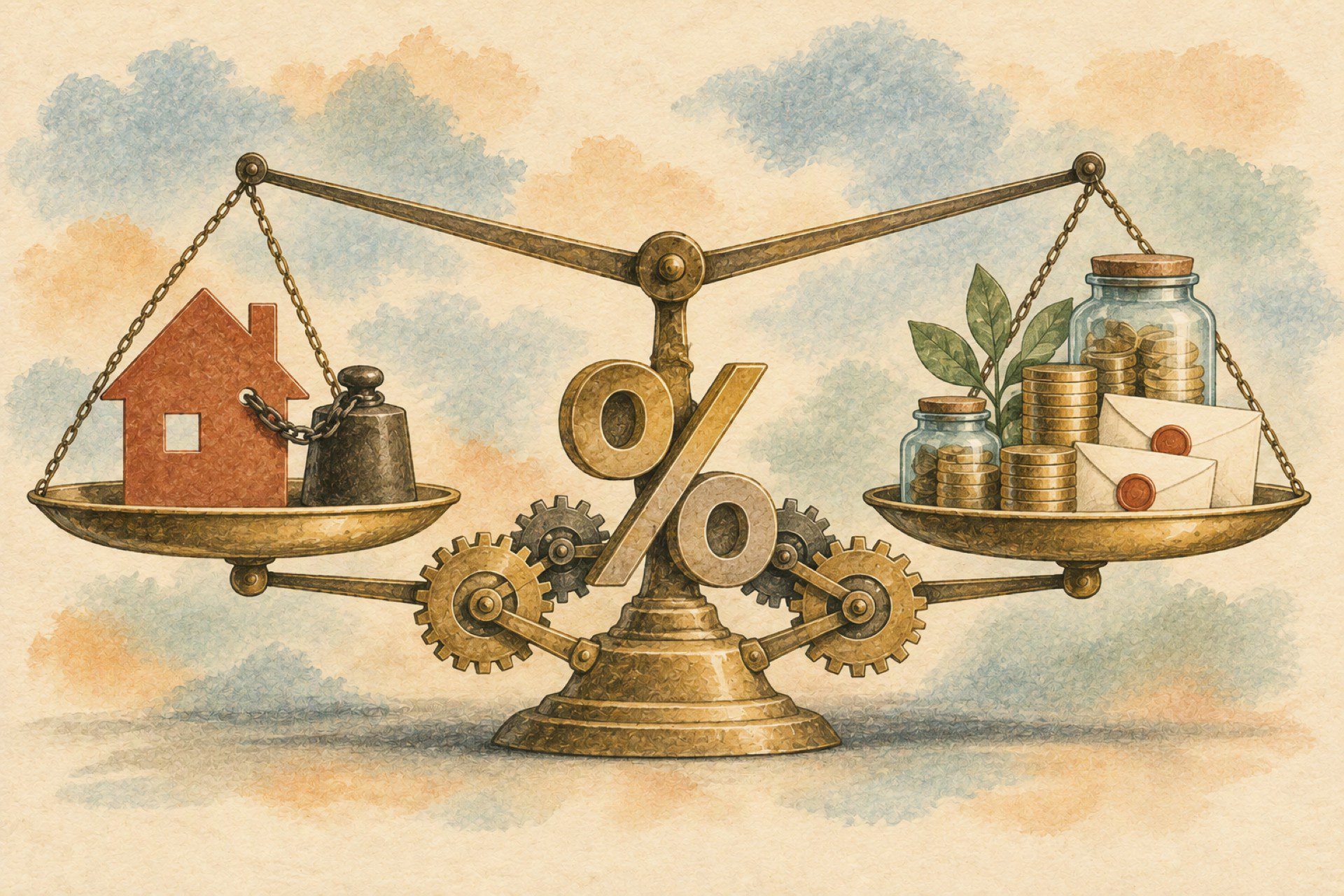
Every change in interest rates creates winners and losers. Higher interest rates redistribute income, wealth and opportunity between different groups throughout the economy. Some Australians pay more. Others earn more. Some experience immediate costs, while others receive benefits that emerge only over time.
Understanding higher interest rates therefore requires looking beyond mortgage repayments and considering how interest-rate changes affect society.
The Most Obvious Losers: Borrowers
The most visible impact of higher interest rates falls on borrowers.
Households with variable-rate mortgages often experience rising repayments within weeks or months of a rate increase. Businesses carrying significant debt face higher financing costs. Property investors may see cash flows deteriorate as interest expenses rise.
For heavily indebted households, even relatively modest increases in borrowing costs can create financial stress.
Research into financial hardship in Australia highlights the role that debt obligations can play in household vulnerability, particularly when economic conditions become more challenging. Langford, R. T. argues that rising debt commitments can significantly influence financial hardship and household resilience. [1]
This helps explain why discussions about higher interest rates often focus on mortgage holders. The effects are direct, visible and immediate.
Borrowers feel the impact first.
The Most Obvious Winners: Savers
While borrowers often receive most of the attention, higher interest rates can benefit savers.
During periods of very low interest rates, households relying on savings accounts and term deposits frequently experience poor returns. In some cases, inflation can exceed deposit rates, reducing the real purchasing power of savings over time.
Higher interest rates can reverse this situation.
As banks raise deposit rates, savers may receive improved returns on cash holdings, term deposits and other low-risk investments.
For households with substantial savings and little debt, higher rates can improve financial outcomes.
This often surprises people because public discussion tends to focus on borrowers. Yet every dollar paid in additional interest by a borrower is also received by a lender or saver somewhere within the financial system.
Interest-rate changes redistribute income rather than simply destroying it.
Retirees Are Not All Affected Equally
Retirees are often described as a group that benefits from higher interest rates.
Sometimes this is true.
A retiree with a mortgage-free home and significant savings may welcome higher returns on bank deposits. Compared with the ultra-low-rate environment that existed during parts of the 2010s and early 2020s, higher interest rates can meaningfully increase income from savings.
However, retirees are not a uniform group.
Some carry debt. Others rely heavily on growth assets rather than cash. Some may face rising living costs that outweigh any additional interest income.
The distributional effects of higher interest rates depend not simply on age but on the structure of a household’s assets and liabilities.
Research examining winners and losers from interest-rate changes finds that wealth composition plays a crucial role in determining outcomes. Households holding financial assets benefit differently from those whose balance sheets are dominated by debt. Greenwald, Leombroni, & Lustig; and Van Nieuwerburgh, identify substantial variation in how interest-rate changes affect different groups depending on their asset and liability positions. [2] [3]
Businesses Face Mixed Outcomes
Businesses often oppose higher interest rates because borrowing becomes more expensive.
A firm considering a new factory, warehouse or expansion project may delay investment when financing costs increase. Highly leveraged businesses can face challenges as interest expenses rise.
However, not every business loses.
Companies with strong cash reserves may benefit from improved returns on deposits. Businesses operating in environments with lower inflation may experience more stable costs and pricing conditions.
The banking sector provides another interesting example.
Research by Anthony Brassil highlights how interest-rate environments influence the Australian banking sector and bank profitability. Extremely low interest rates can compress margins and create challenges for some banking activities, while higher-rate environments can alter profitability in different ways. [3]
The effects are therefore not uniform across all firms or industries.
The Hidden Winners: Future Consumers
One reason central banks raise interest rates is to reduce inflationary pressure.
This objective can make higher interest rates difficult to evaluate.
The costs are usually immediate and obvious.
The benefits often arrive later.
When higher interest rates successfully reduce inflation, households may experience greater price stability. Savings retain more purchasing power. Future wages may go further than they otherwise would.
These benefits are often less visible than a higher mortgage repayment, but they remain economically significant.
As Renee Haltom notes in discussions of monetary policy, the effects of interest-rate changes extend well beyond borrowers and lenders and can influence broader economic outcomes that shape living standards over time. [4]
In this sense, some of the beneficiaries of higher interest rates may be people who do not immediately recognise themselves as beneficiaries at all.
Why There Are No Universally Good Interest Rates
Many public debates treat higher interest rates as either good or bad.
Economics offers a more nuanced answer.
Higher interest rates help some groups and hurt others.
Borrowers often face higher costs.
Savers may receive higher income.
Certain businesses may delay investment while others benefit from more stable economic conditions.
Future consumers may benefit if inflation is brought under control.
Research examining who bears the burden of interest-rate changes consistently shows that the effects are distributed unevenly throughout society. Different households experience different outcomes depending on their debts, assets, income sources and exposure to changing economic conditions. Garry White highlights the importance of examining who ultimately bears these costs rather than assuming that all households are affected equally. [5]
The question is therefore not whether higher interest rates are good or bad.
The better question is: good or bad for whom?
The Politics of Interest Rates
Because higher interest rates create winners and losers, interest-rate debates are never purely technical.
They involve difficult trade-offs between current spending and future stability, between borrowers and savers, and between short-term pain and long-term economic objectives.
This is one reason monetary policy often attracts strong opinions.
People experience its effects differently.
Yet there is another complication.
Even after interest rates change, the economy does not respond immediately. Households, businesses and investors all take time to adjust their behaviour. Some effects emerge within weeks, while others may take months or even years.
Understanding those delays is the final piece of the puzzle.
That question of timing, and why monetary policy takes so long to work, is the focus of the next and final article in this series.
Endnotes
- Langford, R. T. (2023). ‘An Increasingly Middle-Class Phenomenon’: The Causes and Impacts of Financial Hardship in Australia. In. Federation Press. https://dx.doi.org/10.2139/ssrn.6784398
- Greenwald, D., Leombroni, M., Lustig, H., & Van Nieuwerburgh, S. (2026). Winners and Losers When Interest Rates Change&nbsp. https://doi.org/10.2139/ssrn.6240378
- Brassil, A. (2022). The Consequences of Low Interest Rates for the Australian Banking Sector (2022-08). https://www.rba.gov.au/publications/rdp/2022/2022-08.html
- Haltom, R. (2012). Winners and Losers from Monetary Policy. Region Focus, 6–10. https://www.richmondfed.org/-/media/RichmondFedOrg/publications/research/econ_focus/2012/q2-3/pdf/federal_reserve.pdf
- White, G. (2005). Who bears the interest rate burden? Policy (Centre for Independent Studies (N.S.W.)), 21(2), 10–15. https://search.informit.org/doi/10.3316%2Fapaft.104117913215563
Leave a Reply