
Part 5 of the Series: Interest Rates: The Most Important Price in the Economy
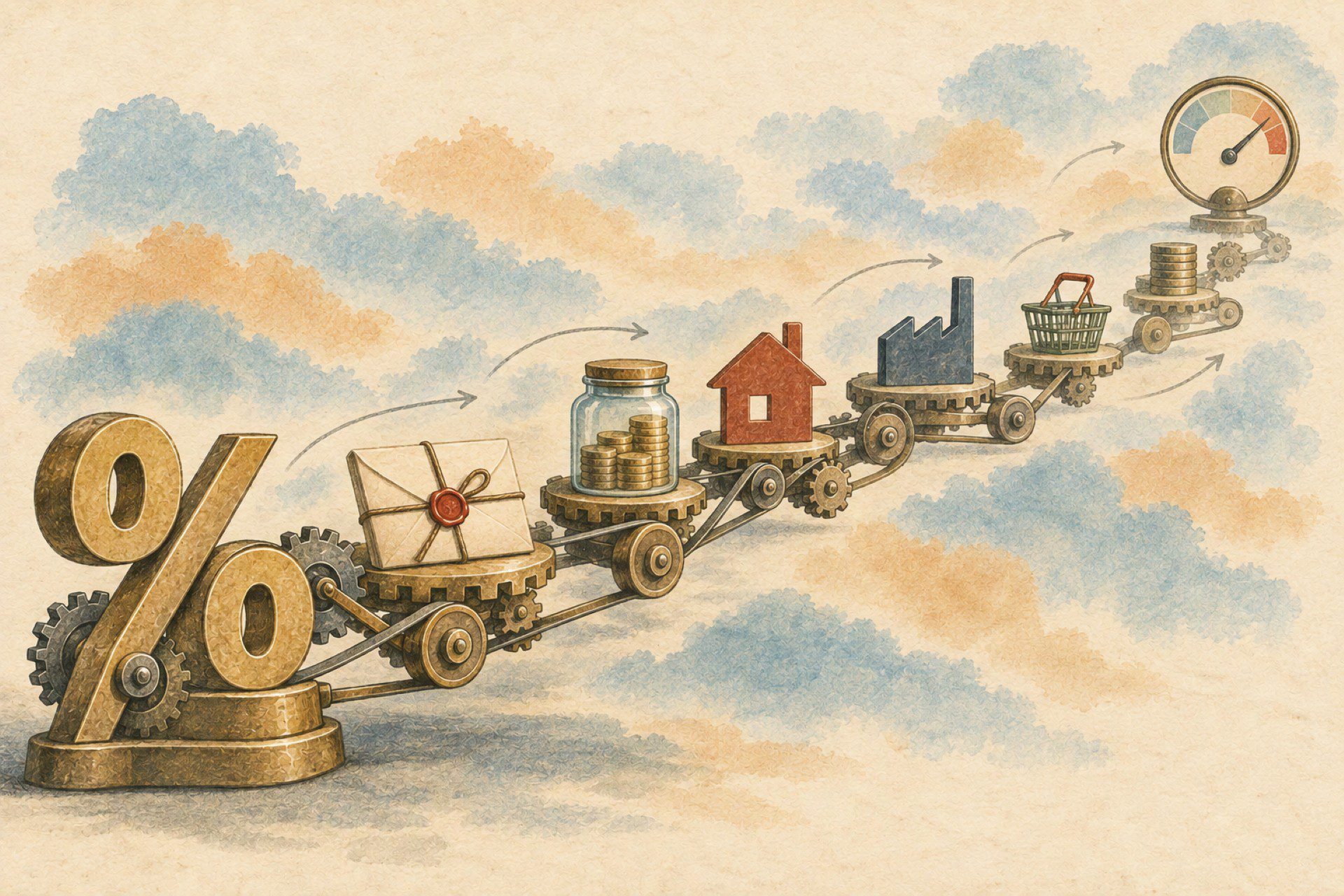
Interest rates can change overnight.
Inflation cannot.
This simple observation sits at the heart of one of the biggest challenges in economic policymaking.
When the Reserve Bank of Australia raises or lowers the cash rate, many people expect immediate results. If rates rise to reduce inflation, shouldn’t inflation start falling straight away? If rates are cut to stimulate the economy, shouldn’t spending start increasing immediately?
Monetary policy works much more slowly.
Changes in interest rates ripple through households, businesses and financial markets over months and sometimes years. Economists refer to these delays as the long and variable lags of monetary policy. [1]
Understanding these lags helps explain why central banks often appear to be looking far into the future. By the time an interest-rate decision has its greatest effect, the economic environment may look very different from the one that existed when the decision was made.
Why Monetary Policy Doesn’t Work Immediately
The cash rate is only the starting point.
When the Reserve Bank changes the cash rate, some financial market interest rates adjust almost immediately. Variable mortgage rates, savings rates and business lending rates begin moving higher or lower relatively quickly. [2]
But people do not instantly change their behaviour.
A mortgage holder facing higher repayments may initially absorb the increase using savings. A business may continue with an investment project already underway. Consumers may take time to reconsider spending plans.
Because economic decisions are made gradually, the effects of monetary policy spread through the economy over an extended period rather than arriving all at once.
The Mortgage Channel
In Australia, one of the most important transmission mechanisms is the mortgage channel.
Higher interest rates increase mortgage repayments for many borrowers. As repayments rise, households have less income available for discretionary spending. Lower spending eventually reduces total demand across the economy. [2]
However, even this process can be delayed.
In a 2023 speech, Christopher Kent noted that an unusually high share of fixed-rate mortgages slowed the transmission of monetary policy during the recent tightening cycle. Many borrowers continued paying historically low fixed rates even after the cash rate had increased substantially. The impact only emerged as those fixed-rate loans expired and borrowers rolled onto higher variable rates. [1]
This meant that the effect of higher interest rates was spread over years rather than months.
Savings Buffers Can Delay the Pain
Another reason monetary policy operates slowly is that households are not passive.
Many Australians accumulated substantial savings during the COVID-19 pandemic. These savings created buffers that allowed households to maintain spending even as borrowing costs increased. [1]
Consider a household with an offset account containing several years of extra mortgage repayments.
Rather than immediately reducing spending after an interest-rate increase, that household may choose to draw on its savings to maintain its lifestyle.
From the perspective of monetary policy, this delays the transmission process.
The eventual impact may still occur, but it takes longer to emerge.
The Five Channels of Monetary Policy
Interest rates affect the economy through more than just mortgages.
According to the Reserve Bank, monetary policy influences economic activity through five major channels: [2]
1. The Cash-Flow Channel
Higher rates increase interest payments for borrowers and increase interest income for savers.
Because borrowers tend to reduce spending more than savers increase it, overall demand slows. [2]
2. The Intertemporal Substitution Channel
Higher interest rates encourage households and businesses to postpone spending and investment.
Saving today becomes more attractive relative to consuming today. [2]
3. The Asset Price Channel
Interest rates affect the valuation of housing, shares and bonds.
Higher rates generally place downward pressure on asset values, reducing household wealth and potentially slowing spending. [2]
4. The Credit Channel
Higher rates reduce borrowing capacity and may make credit harder to obtain.
The Reserve Bank estimates that recent increases in the cash rate reduced borrowing capacity for a typical household by roughly 30 per cent. [2]
5. The Exchange Rate Channel
Higher Australian interest rates can increase demand for Australian assets, supporting the Australian dollar.
A stronger exchange rate can lower import prices and reduce inflationary pressure. [2]
Because these channels operate simultaneously and at different speeds, the full effects of monetary policy emerge gradually.
How Long Do Interest Rates Take to Work?
This is one of the most difficult questions in economics.
Researchers have attempted to measure the lag between interest-rate changes and broader economic outcomes for decades.
One influential Reserve Bank study by Gruen & Romalis and Naveen Chandra estimated an average lag of roughly five to six quarters between a change in interest rates and its effect on economic output. [3]
Their research suggested that:
- Output growth declines in the first year after a rate increase.
- Significant effects continue into the second year.
- Additional effects remain visible in the third year.
- Most of the impact occurs well after the original policy decision. [3]
Importantly, the authors emphasised that these estimates involve considerable uncertainty.
The exact timing varies across cycles and depends on how households, businesses and financial markets respond.
Why The Lags Are Variable
Economists often refer to long and variable lags rather than simply long lags.
The word “variable” is important.
The transmission process changes over time because economic conditions change.
In recent years, fixed-rate mortgages lengthened the transmission process. [1]
At other times, financial conditions may allow policy to move through the economy more quickly.
Research across multiple countries also suggests that institutional factors matter. Countries with large amounts of fixed-rate borrowing often experience slower cash-flow effects than countries like Australia, where variable-rate borrowing plays a much larger role. [2]
This makes it difficult to develop a single rule about how long interest-rate changes take to work.
Why Forecasting Is So Difficult
These lags create a major challenge for central banks.
If the full effects of today’s interest-rate decision may not be felt for more than a year, policymakers cannot simply react to current inflation.
They must forecast where inflation, employment and economic activity are likely to be in the future.
As Christopher Kent observed, if monetary policy operated instantly, central banks could make frequent course corrections. Instead, policymakers must make decisions knowing that much of the impact will occur long after the original decision is made. [1]
This is why interest-rate debates so often focus on forecasts rather than current conditions.
Monetary policy is inherently forward-looking.
Steering A Container Ship
Throughout this series, we have described interest rates as the price of money.
But understanding interest rates also requires understanding time.
The Reserve Bank does not steer a speedboat that can rapidly change direction.
It steers something closer to a container ship. Small adjustments today may not have their greatest impact until many months later.
This is why economists talk about long and variable lags.
Interest-rate changes affect mortgages, borrowing capacity, business investment, household spending, asset prices and inflation. Yet each of these channels operates on its own timetable.
As a result, today’s inflation rate reflects not only today’s interest rates, but also many of the decisions made months or even years ago.
And that may be the most important lesson of all.
In economics, patience is not simply a virtue.
It is often a necessity.
Endnotes
- Kent, C. (2023). Long and Variable Monetary Policy Lags KangaNews DCM Summit, Sydney. https://www.rba.gov.au/speeches/2023/sp-ag-2023-03-20.html
- Kent, C. (2023). Channels of Transmission Address to Bloomberg, Sydney. https://www.rba.gov.au/speeches/2023/sp-ag-2023-10-11.html
- Gruen, D., Romalis, J., & Chandra, N. (1997). The Lags of Monetary Policy. Research Discussion Paper. https://www.rba.gov.au/publications/rdp/1997/9702.html
Leave a Reply